How Different Types of Commercial Properties Should Prepare for Winter

During a major snowstorm, a retail plaza has different priorities than a distribution centre. A medical facility has different requirements than an office campus. Getting winter preparation right means understanding what your specific property type demands and building a snow program around those demands before the season starts.
Here’s how the approach changes across six common commercial property types.
Retail Centres
The challenge at a retail property is maintaining continuous customer access through a storm event and the hours that follow. Retail parking lots see high vehicle turnover throughout the day, which means accumulation patterns change constantly. Plowing needs to account for vehicles arriving and departing throughout the clearing process, and priority needs to shift to storefront walkways, accessible stalls, and main entrances early, before customer traffic builds.
Storefront walkways deserve particular attention. The area directly in front of retail entrances is where slip-and-fall incidents concentrate. Anti-icing treatment at these zones before a freezing rain event or overnight refreeze should be standard in any retail snow program.
Warehousing and Distribution Facilities
Operational continuity is the priority at a distribution facility. These properties require snow programs built around operational sequencing: truck routes and loading bay approaches cleared first, before the first shift arrives or the first delivery is scheduled. For 24-hour operations, that means overnight clearing timed to the schedule of the facility.
Loading areas present specific clearing challenges. Recessed docks, partially enclosed bays, and the compaction that comes from heavy truck traffic all create accumulation and ice formation patterns that differ from the main lot. Drift zones around dock openings need to be identified in the pre-season walkthrough and addressed as part of every service visit.
Learn how Clintar approaches snow and ice management for distribution and warehousing facilities.
Office Properties
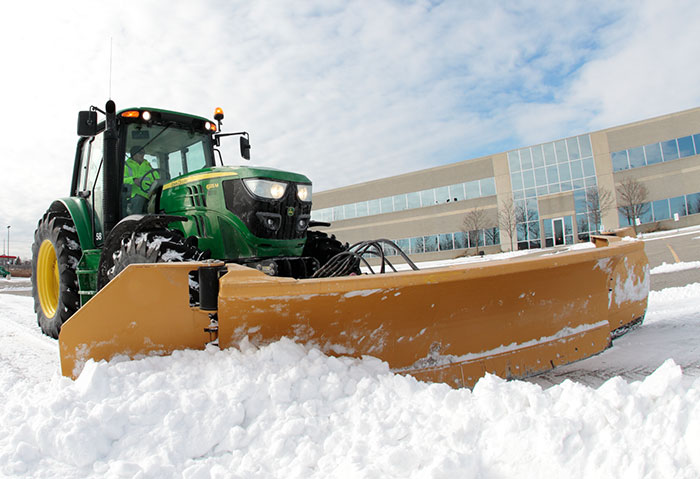
Office properties concentrate their pedestrian traffic into tight windows — the morning arrival, the lunch period, and the end of day. Everything else is relatively quiet. That pattern drives the clearing priority.
The most important service timing at an office property is before the morning arrival window. Entrances, accessible routes, and parking areas need to be cleared and treated before employees arrive.
Pedestrian paths between parking areas and building entrances deserve specific attention. These connecting routes see the highest foot traffic concentration during arrival and departure windows and are often the last areas cleared because they require manual work. They’re also where ice formation is most persistent — shaded, narrow, and in areas where foot traffic compacts snow rather than clearing it.
For multi-building office campuses, connecting paths, covered walkways, and the areas between structures need to be explicitly in scope. They’re easy to deprioritize during a major event when a crew is moving through a large site. They shouldn’t be.
Learn how Clintar approaches snow and ice management for office and commercial properties.
Medical and Institutional Properties
No commercial property type has a lower tolerance for winter access failures than a medical or institutional facility. Hospitals, clinics, long-term care facilities, and other healthcare properties serve people who depend on consistent, unobstructed access.
Zero-tolerance ice control at building entrances and accessible routes is a baseline requirement. Pre-treatment of entrances and pedestrian access points before a forecast freezing rain event, priority clearing of accessible routes and emergency access points, and active monitoring during storm events are the minimum expectations of a professionally managed snow program at a healthcare property.
Documentation matters here as much as it does anywhere. Service verification records are essential at medical properties where regulatory compliance and liability standards are higher than most commercial environments. A snow program that can’t produce those records on request isn’t adequate for this property type.
Response time expectations at medical properties need to be defined clearly in the contract and held strictly. A response time commitment that works for an office park may not meet the operational requirements of a 24-hour medical facility.
Multi-Residential Properties
Property managers overseeing multi-residential buildings face a snow management challenge that’s different from most commercial properties: their stakeholders — building residents — experience the property at all hours, in all conditions, and have higher visibility into service quality than the tenants of a commercial building.
The resident experience of a snow event starts the moment they step outside — often early in the morning, before any clearing has taken place. Parking areas, pedestrian routes to building exits, and the approaches to visitor and accessible parking all need to be in the priority plan. A cleared parking area with an uncleared exit path is a cleared parking area no resident can safely use.
Common areas and underground parking garage entrances require specific attention. Garage ramp entrances are particularly prone to ice formation — the surface sits in shade, sees constant vehicle traffic that compacts snow and brings in moisture, and is often the highest-priority access point for residents in winter conditions. These should be designated priority zones in the service plan.
Communication with building management during and after significant storm events is more important at multi-residential properties than at most commercial types. A property manager who can confirm service was completed, when, and to what standard is in a significantly better position than one who has to make calls to find out.
Industrial Sites

Scale is the defining challenge at industrial properties. Expansive yards, wide access routes, large equipment staging areas, and heavy truck traffic all require a snow program that’s built for large-footprint sites — in terms of equipment, sequencing, and piling capacity.
Standard commercial equipment that works efficiently in a retail or office lot won’t clear a large industrial yard at the pace the operation requires. Industrial snow programs need commercial-grade machinery matched to the scale of the site, with clearing sequences that account for which areas affect operations first — truck access routes and loading zones before secondary areas, every time.
Heavy vehicle traffic creates specific ice hazards that don’t exist at other property types. Trucks that drive through partially cleared areas compact snow into dense, slippery surfaces. Areas where trucks idle create melt-refreeze cycles. Access routes see both vehicle weight and the scraping action of undercarriages that dislodge surface treatments. These conditions require more frequent monitoring and treatment than a typical commercial parking area.
Piling capacity needs to be planned for the full season — not just the first storm. Industrial sites generate more displaced snow volume than most other property types, and piling areas that work in December are often exhausted by February. Snow haulage should be part of the scope conversation from day one.
What Every Commercial Property Type Has in Common
Different property types have different priorities — but the fundamentals of a well-managed snow program apply across all of them.
- Every property needs a pre-season site walkthrough with priority zones documented before the first storm.
- Every property needs a trigger and response time commitment that reflects its actual operational requirements.
- Every property needs service verification records that document every visit.
- And every property needs a snow program that’s built around what the property actually needs.
The time to get that right is now. Contact Clintar to get a quote for your commercial property.